
Overcoming Contamination Issues with Automatic Self-Cleaning Strainers.
Powder coating is a widespread way to apply durable, seamless finishes to components . Unlike regular liquid paints, powder coating does not need harmful solvents, making it safer and better for the environment. It is crucial to have a pure, consistent powder for the process to succeed.
Recently, a significant powder manufacturer faced serious production issues at a new plant, and they started to get customer complaints regarding the quality of their powder production. In this case study, let us explore how a powder coating plant applied a comprehensive Eaton filtration solution to eliminate contaminants and get its production back on track after relocating its facility.

Powder coating essentials
Powder coating covers an object with a thin layer of dry powder that sticks to it and then melts into hard skin when heated. It is usually thicker and more robust than traditional paint. For the powder coating operation to work well, the powder must be consistent from batch to batch in terms of purity, particle size, colour, chemical composition, and thermal properties. Naturally, the methods for producing the powder are trade secrets.
Challenges of Relocating Production
Major powder manufacturers often possess the expertise to produce paint, given the similarities between the two manufacturing processes. The plant in our case study immediately encountered issues when moving its production to a 20-year-old industrial building on the East Coast. These challenges affected their ability to maintain production output and uphold the quality of their products, underscoring the complexities of relocating industrial operations.
They had issues with production, like clogged spray nozzles, chillers filled with sediment, and other equipment wearing out too quickly. But the bigger problem was that their customers were noticing a decline in the quality of the supplied powder. There were too many inclusions, and they produced defects in the finished surface of the customer’s products.
During production, they noticed several challenges, including clogged spray nozzles, chillers clogged with sediment and accelerated wear and tear on other equipment. However, a more significant concern arose when their customers began to notice a decline in the quality of the supplied powder. Excessive inclusions led to defects on the finished surfaces of the customers’ products, highlighting the impact of the relocation on product quality and customer satisfaction.
Tracing issues to water supply
They swiftly identified the root of both issues stemming from the plant’s outdated water supply system. Utilising 2200 litres of water per minute from the city’s supply, the plant cools this water to various temperatures for their processes before recirculating it through a cooling tower in a semi-closed loop system. This setup requires only occasional top-up water from the city’s supply to maintain its operation.
Upon inspecting the plant’s piping system, they uncovered an unwelcome issue: extensive corrosion and intensive sediment clogging. One section of the 6-inch supply pipe was found to be over 50% blocked by scale and sediment, significantly reducing flow, and adversely affecting downstream processes. In response, plant managers initiated a program to replace the most severely affected pipes. They conducted an acid wash to remove the scale buildup. However, the complete replacement of all old pipes proved financially impractical. Pushing for the need for an alternative solution, tackling the root cause of the problem.
Initial Attempts
The facilities management team enlisted the expertise of Engineering Sales Associates (ESA) from Charlotte, North Carolina, to develop a filtration solution aimed at eliminating the root cause of the problem. Brandon Pue, ESA Solutions Manager, was tasked with leading this initiative. Initially, the manufacturers sought to implement point-of-use strainers for each critical component within the production system. Acting on this request, they installed eight 2-inch Eaton Model 72 strainers with 400 mesh elements to safeguard essential equipment. However, it quickly became apparent that a more comprehensive approach was necessary. Pue observed that, beyond just addressing individual points of use, there was a clear need for a solution to purify the entire system.

Enlisting the help of Eaton’s filtration engineers
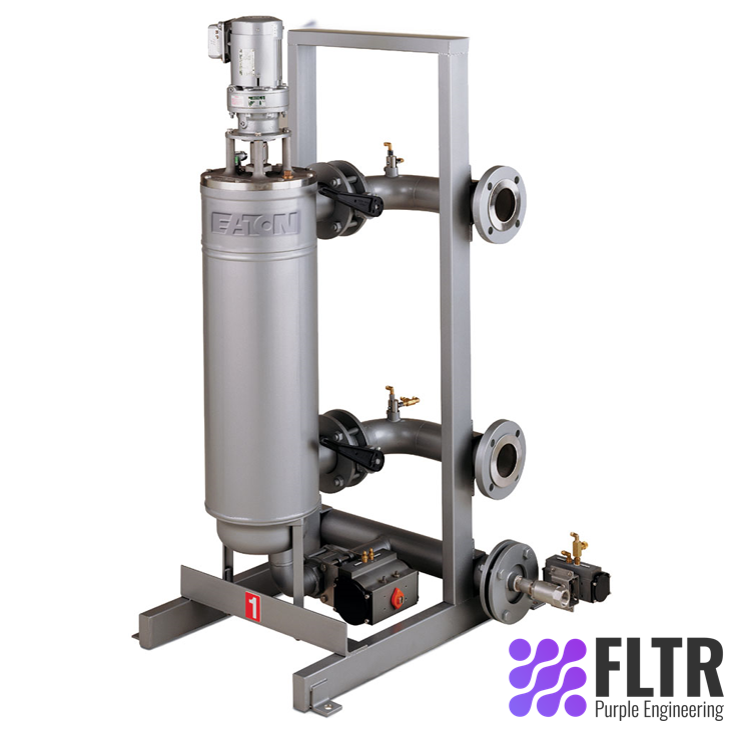
ESA’s analysis concluded that the optimal solution involved continuously filtering the entire flow of 2300 l/minute to 25 microns. However, implementing this solution was challenging. The manufacturer preferred a non-backwashing filter system, and there were also constraints due to the plant’s limited physical space. To overcome these hurdles, the team collaborated closely with Eaton Filtration engineers. After thorough discussions and planning, they decided on a pair of Eaton MCS 1500 series magnetically coupled strainers as the most effective solution.

Crafting an innovative filtration solution
The MCS strainers feature a unique cleaning mechanism: a plastic disc that mechanically cleans the filter screen surface. This disc is magnetically coupled to the piston in the MCS series, eliminating the need for external drive seals and shafts and significantly reducing maintenance costs.
Here’s how the process works: Process fluid enters the strainer at the center and flows out through the discharge, with contaminants collecting on the inside surface of the screen. When flow restriction reaches a preset level, the disc moves up and down, effectively removing contaminants and depositing them at the bottom of the filter housing for purging. This system ensures minimal loss of process fluid during the purging of contaminants. Remarkably, this entire cleaning and purging process occurs without interrupting the flow of liquids.

Results and Impact
The MCS 1500 model is perfectly suited to handle the high flow rate demands of 2300 l/minute. Its fully enclosed design, coupled with the absence of shaft seals, markedly reduces maintenance requirements. It is equipped with two filters, allowing flow diversion and continuous production even during the strainer’s annual maintenance. Eaton’s innovative automatic self-cleaning strainer has made it feasible to implement a comprehensive filtration system despite space constraints.
Customer satisfaction and quality improvement
The introduction of the filtration solution significantly streamlined the powder coating operation. The MCS self-cleaning strainers effectively prevented nozzle and chiller clogs by intercepting contaminants before they could reach and impair critical process equipment. As a result, the plant experienced an immediate boost in powder production, with a reduction in downtime for maintenance and cleaning. More crucially, removing contaminants from the process water markedly improved the powder production rate and consistency. Consequently, customer complaints regarding powder defects saw a dramatic decline.
Conclusion
Contamination poses a significant threat to both production and quality in industrial processing. In this case study, a powder coating plant faced such challenges but found a proactive solution with Eaton’s technology to combat the adverse effects of contaminants.
Opting for an automatic backwash strainer, they chose a practical alternative to the prohibitively expensive option of replacing their entire piping network. Heeding expert advice, the plant installed Eaton’s MCS 1500 high-flow self-cleaning strainers, enabling them to enhance production and the quality of their end product in a cost-effective manner. Ultimately, Eaton’s innovative solution allowed the manufacturer to fulfil customer demands with uncontaminated powder coatings, showcasing the effectiveness of strategic intervention in maintaining production standards.
Enter Keyword or Part Number
Then press enter for search results